The short version
- You will sit at this desk for about 1,600 hours this year. Set it up once.
- Chair first, then screen height, then everything else.
- €150–400 buys a desk that does not hurt. The chair is where the money goes.
Why this matters
A bad setup does not hurt immediately. It hurts at 3pm, then at 6pm, then all day Thursday. A head tilted forward for six hours puts several kilos of extra load on your neck. You do not need the exact figure. You need the top of the screen at eye level.
The wrists are the same story. Bent up at the keyboard for a year is a brace and a physio bill. None of it is dramatic. It is a slow tax on the hours you are trying to work.
The fix is not a €2,000 chair and a motorised frame. It is five measurements and one good chair.
The chair
This is the one thing to spend on. Adjustable height, adjustable lumbar support, and seat depth you can set so the back of your knees clears the edge by two fingers. Second-hand office chairs are the best value in furniture: an ex-office Steelcase or Herman Miller is €150–350 and will outlast three €90 chairs from a furniture chain. Feet flat, knees at about 90 degrees, hips level with or slightly above the knees.
The rest
- Screen height. Top of the screen at eye level, or a finger below it. Arm's length away, roughly 50–70cm. On a laptop that means a stand (€20–40) and a separate keyboard, because a laptop you can see properly is a laptop you cannot type on properly.
- Keyboard. Full size with a number pad only if you use numbers all day. Otherwise a compact one gives your mouse hand more room. €25–40 wired is fine. Mechanical keyboards are a hobby. Nothing about your work requires one.
- Mouse. €20–30. Wired or wireless, it does not matter. If your wrist aches, try a vertical mouse before you buy a brace. If it does not ache, leave it alone.
- Light. One lamp, warm white, on the opposite side from your writing hand so your hand does not cast a shadow. €30–60. Light the wall behind the screen, not the screen. No overhead light only, at nine at night.
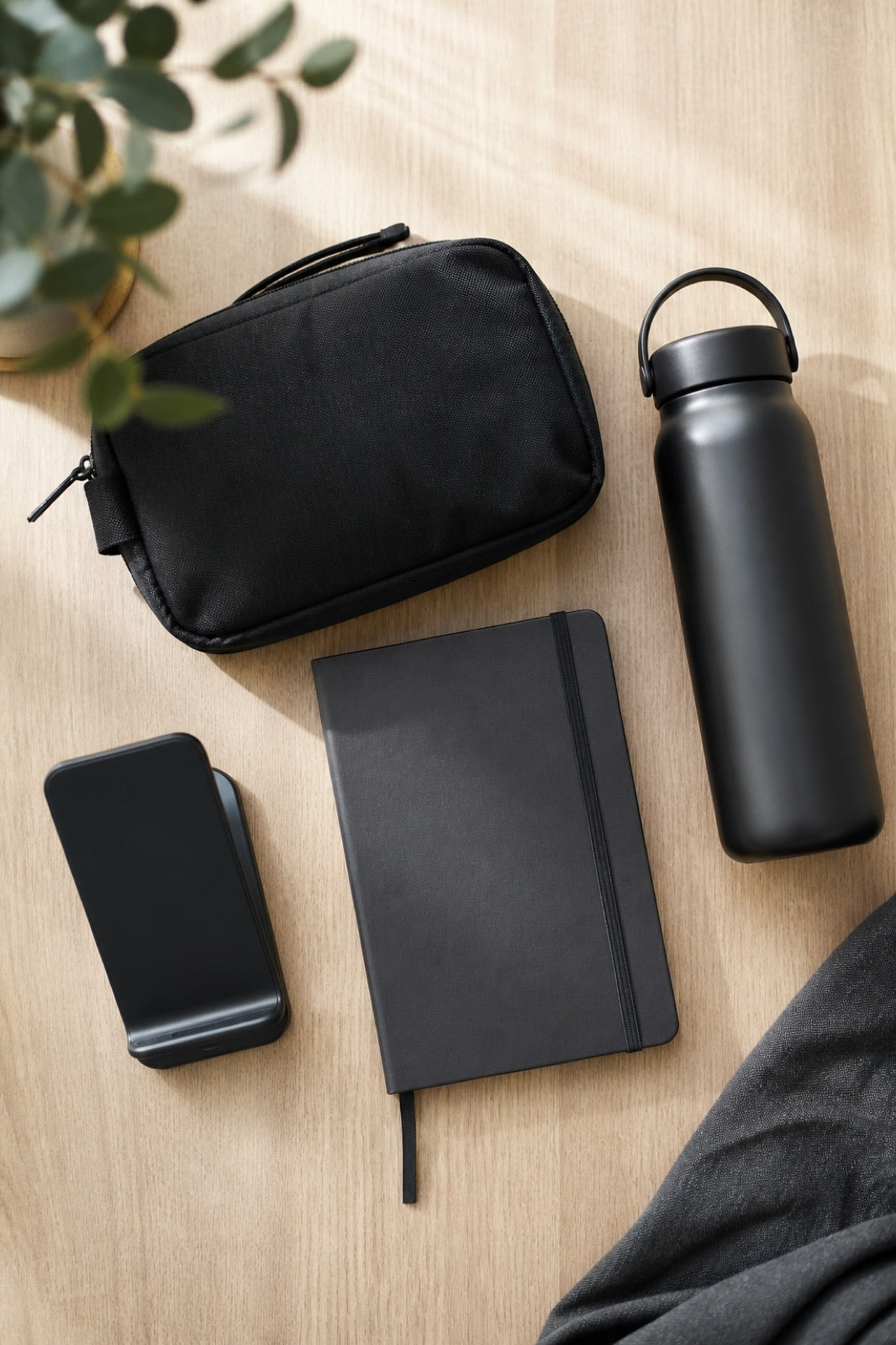
- Cable box. A €10 lidded box or a €15 tray under the desk. Charger, hub, cables, all of it inside. The point is that you can wipe the desk with one hand in ten seconds. A desk you can clear in ten seconds is a desk you clear.
- Notebook. Paper, €5–15, lying open. Three lines a day: what must happen, what happened, what tomorrow's first thing is. The phone is where notes go to be forgotten politely.
- Timer. A €10 kitchen timer or a small clock on the desk. Forty-five minutes on, ten off, and you stand up for the ten. Your phone can do this, but the phone is also the thing that eats the next twenty minutes.
What to skip
The standing desk, if you will not stand. Most sit-stand desks spend their life at sitting height, and the motor is €150 for a button you press twice a month. Three monitors: two is the useful maximum for most work, and the third becomes a place for windows you never read. Desk toys: the brass spinner, the miniature plant, the leather tray for the watch you are not wearing, the group-buy keycaps. Anything on the desk that does not do a job is clutter with a price tag.
What it costs
€150–400 for the setup, assuming you already own a laptop and a lamp. From nothing, closer to €500. Chair €120–350, and a second-hand office chair is the best money in the room. Laptop stand €20–40. Keyboard €25–40. Mouse €20–30. Lamp €30–60. Cable box €10–15. Notebook €5–15. Timer €10. A €400 chair used 1,600 hours a year costs 25 cents an hour. The €40 chair is the most expensive thing in the room.
Your back does not care what the desk looks like. It cares where the screen is.
Do this today
Sit down and look straight ahead. The top of your screen should be at eye level or a finger below. If it is not, put books or a box under it until it is. Ten minutes, no shopping. Then set a timer for 45 minutes and stand up when it goes.